A few months ago I typed a question into Google and never clicked a single result. The answer was just… there, summarized at the top of the page. If that’s happened to you too, you’ve already felt the shift that’s driving all the noise around “AI SEO.”
Here’s the thing — AI SEO isn’t one clean concept. It’s really two different things bundled under one buzzword, and mixing them up is where most beginners get confused.
The first is optimizing for AI-driven search itself — Google’s AI Overviews, ChatGPT, Perplexity, Bing’s Copilot — systems that read your content and decide whether it’s worth quoting. The second is using AI tools to actually do the SEO work: research, writing, audits, tracking. Most people jump straight into the second one because it saves time immediately. But if you ignore the first, you can produce content fast and still watch it go nowhere.
This guide walks through both sides, plus where AI social media fits into the picture, without pretending there’s a single trick that fixes everything.
So What Is AI SEO, In Plain Terms?
Strip away the jargon and AI SEO is just SEO adapted for a world where the “search engine” might be a chatbot instead of a results page. The ranking factors that mattered five years ago — relevance, structure, trust — still matter. What’s changed is how content gets read and by whom (or what).
Google’s algorithm has always used machine learning under the hood, so in one sense “AI SEO” has been around for years. What’s new is generative AI writing the answers directly, and search engines rewarding content that’s easy for a language model to extract a clean, accurate answer from.
That means front-loading your point instead of burying it under three paragraphs of throat-clearing. It sounds simple. Most content still doesn’t do it.
Why This Actually Matters Right Now
I’ll be honest — a lot of “AI is changing everything” content is overhyped. This part isn’t.
Search behavior really has moved faster in the past couple of years than it did in the previous decade. A few things worth paying attention to:
Search engines are rewarding direct answers over padded introductions more aggressively than they used to. Voice search and AI assistants respond better to natural phrasing than to keyword-stuffed strings nobody actually types out loud. And smaller businesses — the kind without a six-figure marketing budget — can now compete on content speed and quality in ways that weren’t realistic before, purely because AI tools cut down production time.
For entrepreneurs, that last point is the one worth sitting with. Visibility used to track pretty closely with budget. It doesn’t anymore, not entirely. For students, it’s a different kind of opportunity — knowing how to work with these tools, not just around them, is becoming something employers actually screen for in interviews.
The AI SEO Tools Worth Knowing (Without the Hype)
New tools launch every week, and honestly, most of them do the same handful of things with different branding. It’s more useful to know the categories than to memorize product names that might not exist in a year.
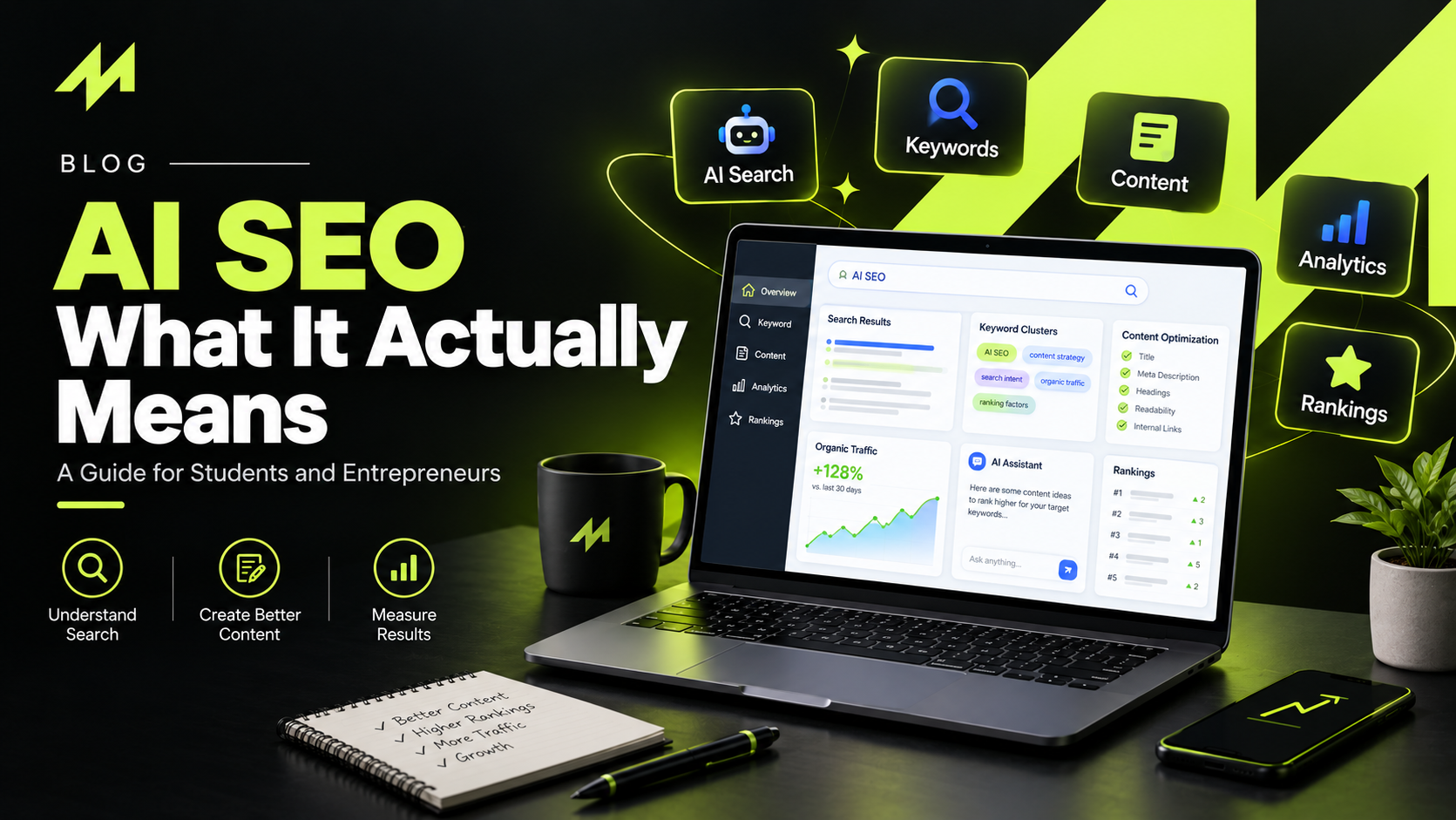
Keyword and content research tools use AI to cluster related searches and spot gaps a competitor missed — work that used to mean hours in a spreadsheet, now closer to minutes.
Writing and optimization assistants draft content and check it against what’s already ranking. Useful for a first pass. Not something you should publish without a human actually reading it first, and I mean really reading it, not skimming.
Technical auditors crawl a site and flag broken structured data, slow pages, and crawl errors — the unglamorous stuff that quietly tanks rankings if nobody’s watching.
And then there’s a newer category: tools tracking whether your brand gets mentioned inside AI-generated answers at all, sometimes called AI visibility or share of voice. This one’s still maturing, but it’s worth keeping an eye on.
Where AI Social Media Fits In
Here’s something that surprises people: search and social aren’t separate lanes anymore. Search engines increasingly pull in content from social platforms and video captions, so a decent social presence ends up supporting your SEO whether you planned it that way or not.
AI Social Media tools now help plan content calendars, suggest posting times, and repurpose one blog post into five different short-form captions. For a small team, or an entrepreneur wearing five hats already, that kind of automation buys back real hours.
The catch — and it’s a real one — is that AI-drafted social content tends to sound the same as everyone else’s AI-drafted social content. Audiences notice. So do search engines, increasingly. Treat AI as a starting point for a caption, not the final version.
Mistakes I See Constantly
Publishing AI content without editing it is the big one. It reads fine at a glance and falls apart on a second read — generic phrasing, no real point of view, nothing that couldn’t have been written about any other business in the same niche. Search engines have gotten noticeably better at spotting this pattern too.
Chasing the keyword while missing the actual question is another. You can hit every “optimization” checkbox and still fail to answer what someone genuinely wanted to know when they searched.
And treating any of this as a one-time setup. Algorithms shift, AI models get updated, competitors catch up. Whatever’s working right now probably needs revisiting in three months, not never.
If You’re Just Starting Out
Students: learn the fundamentals first — search intent, on-page structure, why headings matter — before leaning on AI tools. It’s much easier to spot when an AI suggestion is wrong if you already know what a good answer looks like. Then practice on something real, even a small personal blog, so you’ve got actual examples to show later.
Entrepreneurs: don’t try to fix everything on your site at once. Run an AI audit, pick the two or three issues that’ll actually move the needle, and start there. Build a simple content routine where AI speeds up the drafting but a real person — you, or someone on your team — has final say before anything goes live.
A Few Questions People Ask
Is AI SEO really different from regular SEO, or is it just a new name for the same thing?
Mostly the fundamentals haven’t changed — relevant content, solid structure, real authority. What’s new is the layer on top: using AI tools to move faster, and shaping content so it performs well inside AI-generated answers, not just on a traditional results page.
Do I need a technical background to get into this?
Not really. Most AI SEO tools are built for people without a coding background — clean dashboards, plain-language suggestions. Understanding how search actually works matters more than knowing how to code.
Is AI going to replace SEO jobs?
Doubtful, at least for the strategic side. AI speeds up research and drafting, sure. But reading a room, adjusting strategy when something isn’t working, keeping content actually good — that still takes a person paying attention.
Where This Leaves You
AI SEO isn’t a trend that’s going to quietly disappear next year. It’s a real shift in how content gets found and read. Students who pick this up early have a genuine edge walking into interviews. Entrepreneurs who use these tools well can compete for attention without a big budget behind them. The people who do best with any of this tend to be the ones using AI to think better and faster — not the ones hoping it’ll think for them.