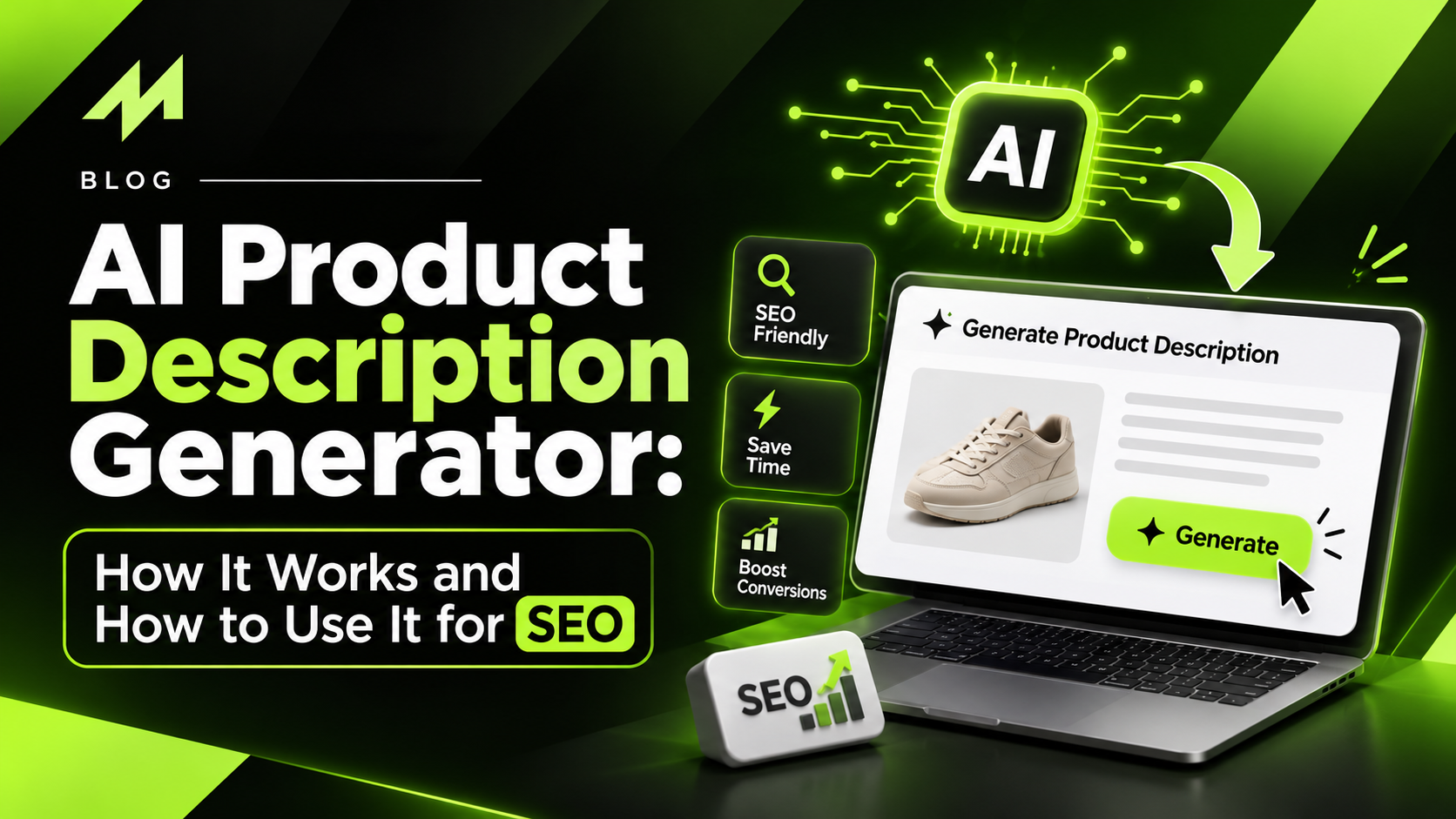
If you’ve ever had to write descriptions for 400 products before a Friday launch, you already know why people are curious about an AI product description generator. It’s tempting. You paste in some details, click a button, and a draft appears.
But a draft isn’t a finished page. This guide covers what these tools actually do, where they help, where they quietly cause problems, and how to fit them into an SEO workflow without ending up with a catalog full of bland, repetitive copy. It’s written for developers, business owners, and SEO people who want a straight answer.
What is an AI product description generator?
It’s a tool that writes product copy from details you give it: materials, dimensions, who it’s for, what makes it different, the tone you want. It returns a draft. That’s all.
The useful part is speed. A person might take ten minutes to write a decent description, and a generator takes seconds. Across a big catalog, that gap is huge.
The catch is that the tool only knows what you tell it. Feed it thin details and you’ll get thin copy back, usually padded with phrases like “perfect for any occasion” that say nothing.
Why descriptions matter more than people think
Most product pages are a photo, a price, and a button. The description is often the only real text on the page, so it carries a lot of weight.
It tells search engines what the page is about. It also answers the questions a shopper has but won’t bother to email you about: Does it fit? Is it durable? Will it work with what I already own?
There’s also the duplicate content problem. Plenty of stores copy the supplier’s text word for word, which means dozens of pages say the same thing. Search engines have no reason to pick yours. Even a modestly original description gives you an edge.
How these tools work in practice
The process is simple. You enter the product details and a keyword, choose a tone and length, and the tool produces one or more drafts. Then you edit.
That last step is where most of the value gets decided. People who treat the output as final tend to end up with pages that sound the same, and shoppers notice. The people getting good results treat the draft like a junior writer’s first pass: useful, fast, and in need of a careful read.
What to look for when choosing one
Skip the feature lists on sales pages and ask a few practical questions.
Can it handle bulk uploads? If you have a large catalog, typing products in one at a time defeats the purpose. Can you control the keyword and the length? Can it hold a consistent brand voice across hundreds of pages? And if you’re a developer, is there an API, so you can connect it to your product management system instead of copying and pasting?
Multilingual output matters too if you sell in more than one region, though you’ll want a native speaker to check it.
Where AI SEO tools come in
A generator writes. It doesn’t tell you whether the page will rank. That’s the job of AI SEO tools, and the two work well together.
Use keyword research to find what shoppers really type, including the long, specific phrases that convert. Use a content scoring tool to compare your draft against pages already ranking. Run a duplicate check so you don’t publish ten near-identical descriptions by accident. Then write the title tag and meta description to match.
This is the kind of setup a performance marketing agency usually builds for ecommerce clients, because it ties copy to results instead of just producing more words.
What makes a description actually good
Start with the benefit. Nobody searches for “100% cotton, 220 GSM.” They want a shirt that doesn’t go shapeless after three washes. Say that first, then give the specs.
Use your keyword where it fits naturally, in the opening lines and the metadata, and don’t force it after that. Keep paragraphs short, because most of your visitors are on a phone.
Check every fact. Language models sometimes invent specifications with total confidence. A wrong battery life or a made-up certification can cost you returns and trust, so someone has to verify the details before anything goes live.
And add what the tool can’t know. Real customer questions, care tips, sizing notes from your support team, a line about who it’s actually best for. These details are what make a page feel like it came from a business rather than a template.
Mistakes I see again and again
Publishing raw output without reading it is the big one. Close behind is using one template for every product, so your pages read like clones of each other. Then there’s keyword stuffing, which still happens, and ignoring search intent, like writing a hard sales pitch when the searcher wants a comparison.
The last one is skipping the fact check. It sounds minor until a customer complains.
Who gets the most out of it?
Developers can connect a generator to the store backend so new products arrive with a draft already waiting. Business owners with large or changing catalogs save real hours every week. SEO specialists can test different description styles and see which ones lift rankings and conversions.
A D2C marketing agency, or a digital marketing company in Jaipur working with growing online brands, can use the same approach to launch new product lines faster while keeping the messaging consistent across the site, ads, and social.
A workflow that holds up
Gather accurate product data first. Pick a main keyword and a couple of related ones for each product group. Generate a draft, then rewrite the parts that feel generic. Check it against a content score and a duplicate check, publish, and watch rankings, click-through rate, and conversions for a few weeks. Update whatever underperforms.
Start with ten or twenty products before touching the full catalog. You’ll learn what inputs work for your brand much faster on a small batch.
Frequently asked questions
Does AI-written product copy hurt SEO?
Not by itself. Search engines care whether a page is useful and accurate. Unchecked, repetitive, or duplicated text is what hurts you.
How long should a product description be?
It depends on the product. A simple item might need 50 to 100 words. Something expensive or technical deserves 200 to 300, with specs and answers to the usual questions.
Can I generate descriptions in bulk?
Yes, most tools allow it. Read a sample from every batch before publishing the whole set.
Do I still need a human editor?
Yes. Someone has to check accuracy, keep the voice consistent, and add the specific details that make a page trustworthy.
The short version
An AI product description generator is a fast first draft, nothing more and nothing less. Give it good information, guide it with real keyword research, check the result with AI SEO tools, and finish with a human edit. Do that, and you get scale without the bland sameness that makes shoppers leave.