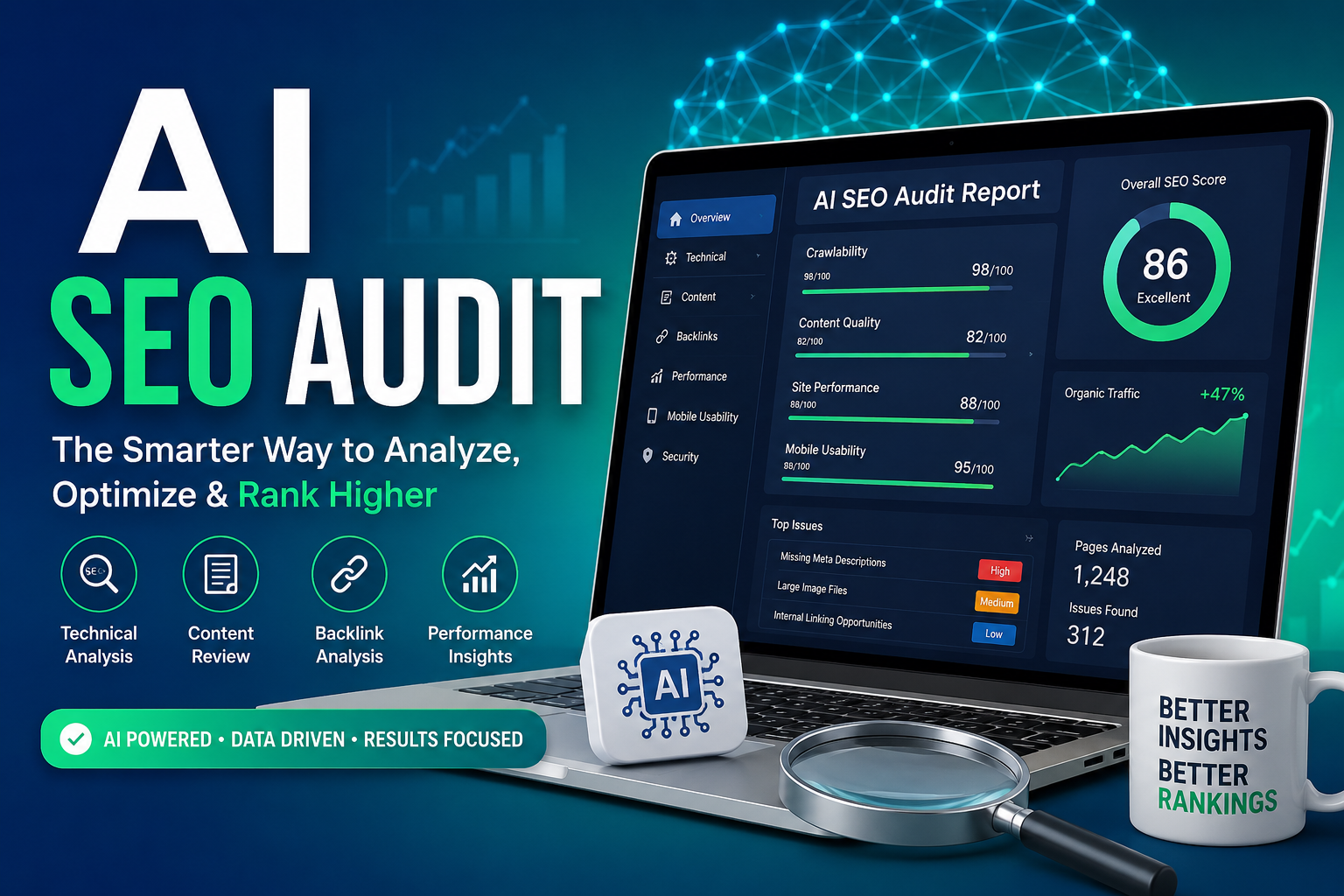
If you’ve ever opened an SEO tool, stared at hundreds of warnings, and wondered where to begin, you’re definitely not alone. I’ve seen website owners spend hours fixing tiny issues that barely moved the needle while completely missing the problems that were quietly hurting their rankings. That’s one reason an AI SEO audit has become so valuable. Instead of simply dumping a checklist in front of you, modern AI tools can identify patterns, explain why something matters, and even suggest practical fixes.
That doesn’t mean AI magically replaces SEO expertise. It doesn’t. Think of it more like having a really fast assistant that notices things you might overlook after staring at the same website for weeks.
The trick is knowing how to use those insights without blindly following every recommendation. That’s where AI optimization helps separate meaningful improvements from unnecessary fixes.
Why an AI SEO Audit Feels Different
A traditional SEO audit usually produces a long report packed with technical warnings. Some are important. Others…not so much.
The problem is that many reports treat every issue as equally urgent.
An AI SEO audit looks at your website with more context. Instead of only telling you that a page is missing an image alt tag, it can recognize broader patterns. Maybe your blog posts consistently fail to answer search intent. Maybe your product pages compete against each other. Perhaps your internal links unintentionally send users in circles.
Those are problems that don’t always stand out in a standard report.
I remember reviewing a client’s site that had nearly perfect technical scores. On paper, everything looked healthy. Yet traffic had dropped for months. The real issue wasn’t broken links or page speed—it was thin, repetitive content spread across dozens of pages. AI spotted the duplication almost immediately, saving hours of manual review. It’s the kind of issue a digital marketing agency encounters regularly when auditing growing business websites.
That’s where these tools really shine.
An SEO Audit Is About More Than Technical Errors
Many people assume a website audit is just a hunt for broken links.
It’s much broader than that.
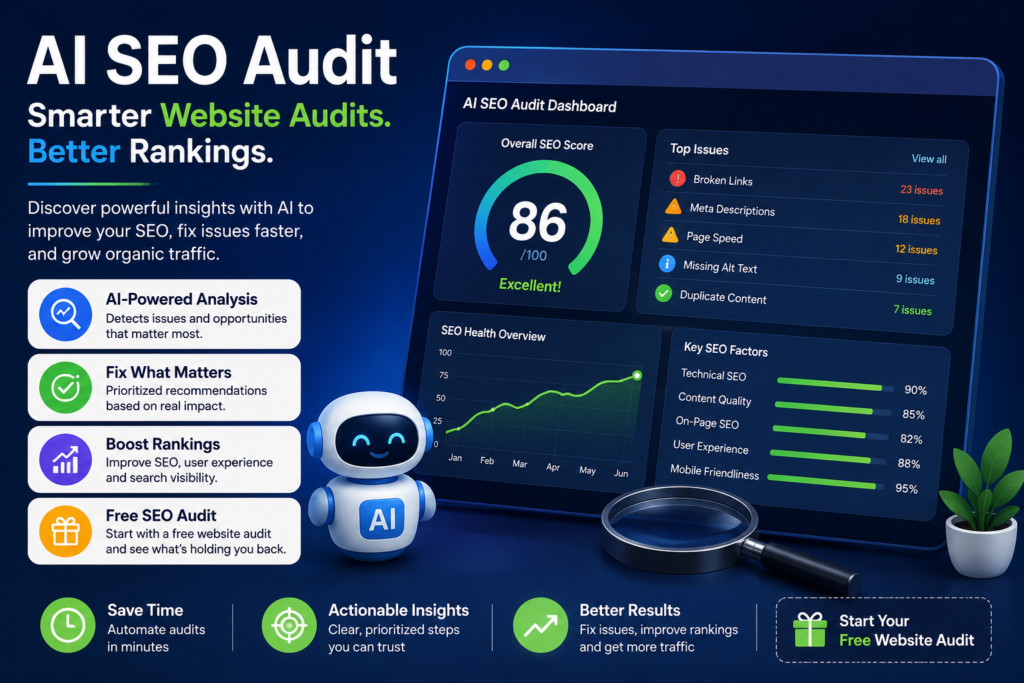
A complete SEO audit looks at several parts of your website working together:
- Technical SEO
- Content quality
- Internal linking
- User experience
- Mobile usability
- Page speed
- Indexing
- Crawlability
- Metadata
- Keyword targeting
Imagine walking into a house before buying it.
You wouldn’t only check whether the front door opens. You’d look at the roof, plumbing, electrical system, insulation, and foundation.
Your website works the same way.
One small issue rarely causes major ranking losses. It’s usually dozens of tiny weaknesses that slowly add up over time.
Where AI Actually Saves Time
People often think AI is valuable because it’s fast.
That’s true, but speed isn’t the biggest advantage.
Consistency is.
After you’ve reviewed fifty pages, your attention naturally drops. You begin overlooking repetitive mistakes. AI doesn’t get tired. It applies the same standards across every page.
That’s especially useful for larger websites.
An ecommerce store with 8,000 products simply can’t be reviewed page by page manually. An SEO audit AI system can scan the entire site in minutes and highlight recurring issues that deserve attention first.
Instead of reading thousands of URLs individually, you’re looking for patterns.
That’s a much better use of your time.
Don’t Expect AI to Replace Human Judgment
One of the myths about AI-powered SEO is that you should do everything it tells you to do.. That is not true. AI-powered SEO gives you ideas. You have to think about which ones are good for your website and what you want to achieve. AI-powered SEO is a tool it is up, to you to decide what to do with the suggestions it gives you about your website and your goals.
Sometimes AI recommends shortening content that actually performs well because it’s comprehensive. Other times it suggests adding keywords where they’d sound awkward.
I’ve ignored plenty of AI recommendations over the years because they didn’t fit the audience.
Context still matters.
For example, a legal website, an online clothing store, and a personal travel blog shouldn’t sound alike just because an algorithm recommends similar sentence lengths.
Use AI as guidance—not as your final editor.
That’s the mindset that produces the best results.
What a Good Website Audit Should Reveal
A thorough website audit should answer questions that actually matter.
For example:
- Why are certain pages losing rankings?
- Which pages receive impressions but very few clicks?
- Where are users leaving your site?
- Which pages compete against each other?
- Are search engines crawling the right content?
- Which articles deserve updates instead of replacements?
Notice that none of those questions focus on chasing a perfect SEO score.
High scores look nice in reports.
Traffic pays the bills.
There’s a big difference.
Can You Trust a Free SEO Audit?
The answer depends on what you’re expecting.
A free SEO audit is great for identifying obvious problems.
Missing title tags.
Broken pages.
Redirect chains.
Large image files.
Slow-loading pages.
Those are useful discoveries.
However, free tools rarely explain the bigger picture. They might tell you that twenty pages have duplicate titles without explaining whether those pages are actually hurting performance.
That’s where paid platforms—and increasingly AI-powered analysis—provide more value.
It’s the difference between getting a list of symptoms and receiving an actual diagnosis.
Why Search Intent Still Beats Perfect Optimization
Here’s something I’ve noticed repeatedly.
Websites sometimes obsess over technical perfection while ignoring what visitors actually want.
You can have flawless metadata, blazing-fast load speeds, and structured data everywhere.
If your page answers the wrong question, rankings won’t last.
One client insisted on optimizing a page around industry jargon because competitors were doing it.
Visitors weren’t searching that way.
We rewrote the content using simpler language, added examples based on customer questions, and reorganized the headings.
Traffic increased within a few months—not because the technical SEO suddenly improved, but because the content finally matched search intent.
An AI SEO audit can often recognize those mismatches by comparing your content with top-ranking pages.
That’s incredibly useful, especially if you’ve been staring at the same content for years.
The Biggest Mistakes Website Owners Make
Ironically, the biggest SEO mistakes usually aren’t technical.
They’re strategic.
People publish dozens of similar articles targeting almost identical keywords.
They forget to update content that’s three years old.
Also, they ignore internal linking.
They write introductions that take forever to reach the main point.
Or they chase every new SEO trend without asking whether it fits their audience.
A smart SEO audit AI system can highlight many of these recurring habits.
It won’t solve them automatically, but it gives you a much clearer starting point than manually digging through hundreds of pages.
Should You Run a Free Website Audit Regularly?
Absolutely, a free website audit won’t replace a complete SEO review, but it’s an excellent habit.
Think of it like checking your car’s tire pressure. You don’t wait until the engine fails before looking under the hood.
Running a free website audit every month helps catch issues before they become larger problems.
Maybe someone accidentally added a noindex tag.
And images suddenly became much larger after a redesign.
Maybe a plugin update created redirect errors.
Small problems are much cheaper to fix than major ones.
AI Doesn’t Make SEO Easier—It Makes Decisions Faster
This is probably the biggest lesson I’ve learned.
Years ago, SEO involved hours of spreadsheets, manual crawls, and endless comparisons.
Today, AI handles much of the repetitive analysis.
That doesn’t eliminate the work.
Instead, it shifts your attention toward strategy.
You’re spending less time hunting for problems and more time deciding which improvements will have the biggest impact.
That’s a much better trade-off.
The websites that benefit most aren’t necessarily using the most AI tools.
They’re using AI to support smart decisions rather than replace them.
Final Thoughts
Using an intelligence search engine optimization audit is not a quick way to get higher rankings and it will not instantly put your website at the top of Google. However, it can make the entire search engine optimization process easier to understand.
You do not have to spend a lot of time looking through reports because artificial intelligence helps you quickly find the areas that need your attention. Artificial intelligence search engine optimization audits highlight problems, identify opportunities, and give you a good place to start. Then your experience and judgment are what turn those ideas into improvements.
Whether you have a blog, an online store or a business website, it is a good idea to do search engine optimization audits regularly not just when your traffic drops. Checking your website every month and doing a detailed audit every few months can help you find problems early and keep your site working well.
At the time, remember that artificial intelligence is just a tool, not a replacement for a plan. The best results happen when you combine intelligence ideas with good content, a great user experience and ongoing optimization.
In the end, successful search engine optimization is not about fixing every problem on your website. It is, about making improvements that help both search engines and your visitors. When you use artificial intelligence for search engine optimization audits, it can save you time, keep your website healthy and help you focus on the changes that really make a difference.

1 thought on “AI SEO Audit: The Smarter Way to Find What’s Holding Your Website Back”