We’ve all been there. You open a new AI optimization tool, type in a prompt, and get back a wall of text that sounds like a college freshman trying to hit a word count. It’s polite, it’s grammatically perfect, and it is entirely devoid of a human soul.
In the last eighteen months, the corporate world has sprinted toward a singular goal: AI optimization. Digital Marketing Agency Jaipur. obsessed with integrating Large Language Models (LLMs) into every crevice of our workflows. We want them to write our emails, summarize our meetings, and draft our marketing copy. But in this rush to “automate everything,” many of us have hit a wall of diminishing returns. We’ve traded personality for efficiency, and in doing so, we’ve made our communications remarkably forgettable.
If you want to use AI to actually help your business—rather than just flooding the internet with beige content—you need to shift your focus. True AI optimization isn’t about letting the machine take the wheel; it’s about knowing exactly when to kick it out of the driver’s seat. Also, you can use an AI website builder to create your website.
What Actually Is AI Optimization?
Most people think AI optimization means “getting the AI to do more work.” That is a trap.
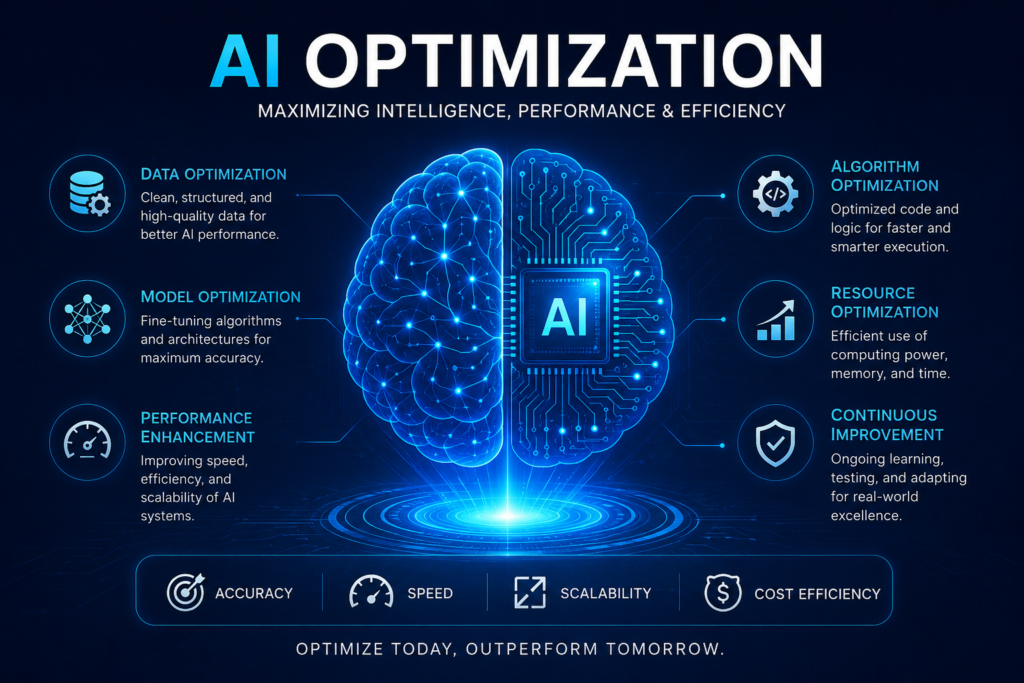
In a professional context, AI optimization is the strategic process of using machine intelligence to handle high-volume, low-context tasks so that your human brain can focus on low-volume, high-context strategy.
Think of it like a sous-chef. You wouldn’t let the sous-chef design the signature dish for your restaurant, but you absolutely want them chopping the onions, prepping the pans, and cleaning the station. When you try to make the sous-chef the head chef, the food loses its edge. When you treat AI as the star of the show rather than the support staff, your brand voice starts to flatten.
The Three Pillars of Human-Centric Optimization
If you want to integrate AI without sounding like a robot, you need a framework that prioritizes human judgment.
1. The “Data-First, Draft-Second” Rule
Never ask an AI to “write a blog post about X.” It will hallucinate facts, lean on clichés, and use transition words like “In today’s fast-paced digital landscape” until you want to scream.
Instead, feed the AI the “meat” of the content. Give it your internal data, your specific customer anecdotes, and your unique point of view. Ask it to organize those thoughts, not generate them from thin air. When the AI is working with your raw materials, the output remains tethered to reality.
2. Radical Structural Editing
AI models love symmetry. They love five-point lists and perfectly balanced paragraphs. Human thought is rarely that clean. We make leaps; we use humor; we embrace nuance.
Once your AI generates a draft, the most important work begins. You must be willing to:
- Cut the fluff: Delete the introductory paragraph that says “In this article, we will explore…”—the reader already knows what the article is about.
- Inject friction: Add a controversial opinion or a personal story that the model couldn’t possibly know.
- Vary the rhythm: Mix short, punchy sentences with longer, explanatory ones.
3. The “Voice Check”
Before you hit publish, read the content out loud. If you stumble over a sentence, or if the phrasing sounds like something a lawyer would write in a settlement agreement, change it. If you wouldn’t say it to a client over coffee, don’t put it on your blog.
Why “Good Enough” is Killing Your Brand
The biggest danger of AI optimization is the temptation to settle for “good enough.” Because AI can produce passable work in seconds, we are seeing a massive surge in “middle-of-the-road” content.
Here is the problem: In a world saturated with AI-generated text, the average is invisible.
Algorithms—both on Google and on social media—are increasingly prioritizing engagement signals like dwell time, shares, and comments. Nobody shares a generic summary of a topic they can find on a thousand other websites. They share insights that feel human, vulnerable, or unexpectedly clever.
If your AI optimization strategy is just to crank out more content, you aren’t optimizing for growth; you’re optimizing for noise. You are adding to the digital landfill.
When to Walk Away from the Prompt
There are specific moments where AI optimization should be strictly forbidden:
- Thought Leadership: If you are sharing a vision for the future of your industry, AI cannot help you. It only knows the past. It is mathematically incapable of having a “hunch.”
- Crisis Communication: When you need to apologize or address a sensitive issue, transparency is currency. An AI-written apology feels calculated and cold—the exact opposite of what you need in a moment of vulnerability.
- Customer Relationships: If you are nurturing a lead or consoling a frustrated client, leave the chatbot behind. Empathy is a human-only feature.
The Future Belongs to the “Centaur”
The most successful companies of the next decade won’t be the fully automated ones. They will be the “Centaurs”—half-human, half-machine.
They will use AI to handle the tedious research, the SEO keyword tagging, and the initial formatting. But they will rely on human writers and thinkers to provide the “Why.” They will use AI to be faster, but they will use human intuition to be better.
AI optimization isn’t about replacing the spark of human creativity; it’s about clearing away the brush so that the fire can burn brighter. Stop asking the AI to sound smart. Start using the AI to help you be smart. The technology is a tool, not a replacement. Use it to build something that actually matters—something that feels like it was written by a person, for a person.
In a sea of synthetic noise, authenticity is the ultimate competitive advantage. Don’t automate yourself out of a job; automate the work you hate so you can spend more time on the work that defines you.